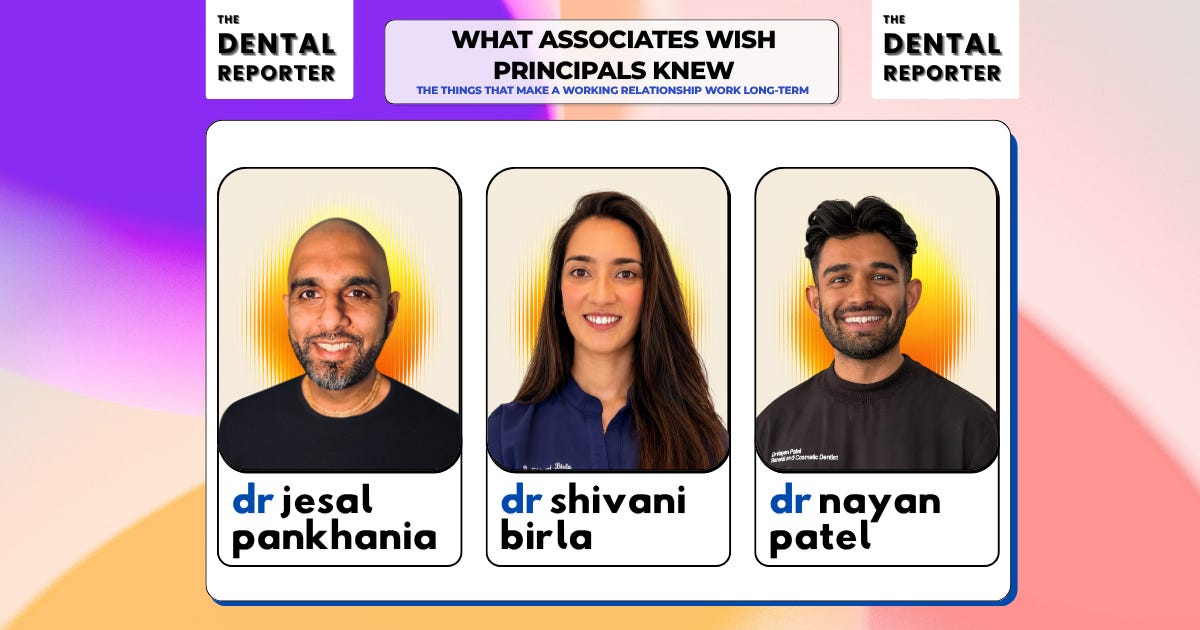
Most guidance on this relationship is written for principals, by principals. Three associate dentists describe what makes the relationship thrive instead, and the pattern turns out to be narrower than expected.
The question put to associate dentists was not what principals get wrong. It was what the best principal they had worked for did differently, and what one change would matter most now. Across different career stages, all three landed on the same four behaviours and none of them is contractual.
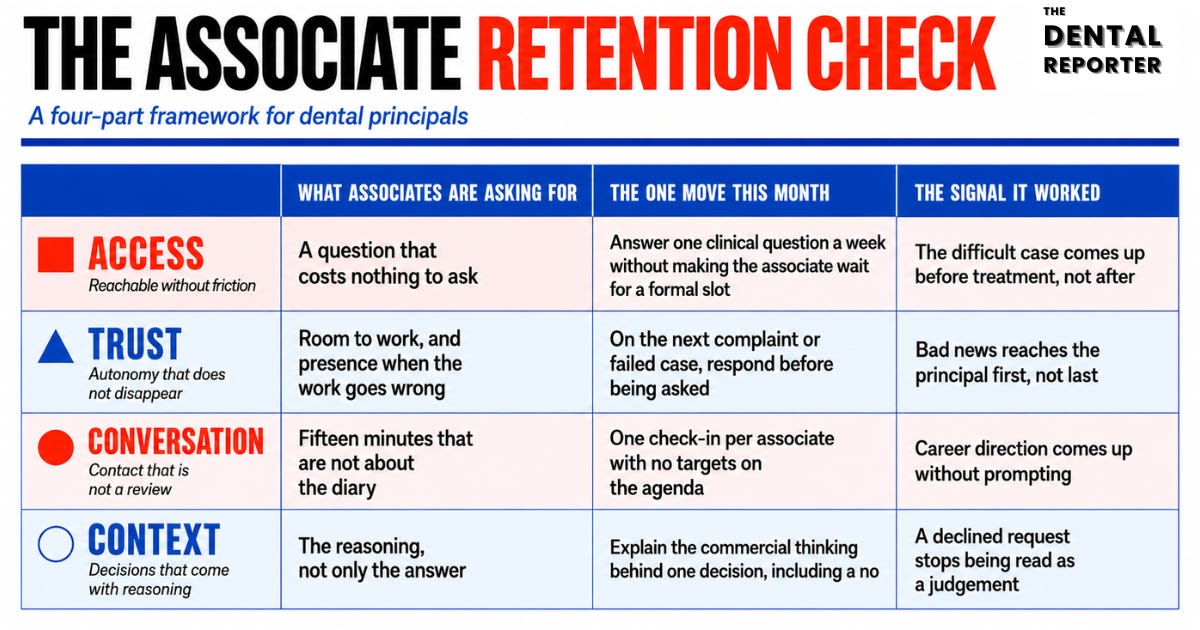
Access, trust that holds when a case turns, conversation with nothing to do with output, and a visible return on what the associate puts in.
Contributors
Dr Jesal Pankhania, Kettering Dental and Implant Clinic, Aspects Dental and Referral Centre and Pennington Dental
Dr Shivani Birla, Pentangle Newbury Bupa
Dr Nayan Patel, Ascent Dental Care Solihull





Access is the first test
Contributors do not open with money or mentorship. They open with whether a question costs anything to ask.
“They were approachable, took the time to answer questions and were always happy to share their knowledge without making me feel like I was interrupting them,” says Dr Shivani Birla, Pentangle Newbury Bupa. The return on that is clinical rather than emotional. Confidence, in her account, is what makes an associate raise the difficult case instead of pressing on alone. “It gives you the confidence to discuss challenging cases, ask for a second opinion and continue learning without feeling judged.”
Dr Nayan Patel, Ascent Dental Care Solihull, worked for principals running a group of practices who still made themselves reachable. “Even with busy family lives and running a group of practices, both my principals would often be on calls with me until 10pm midweek discussing cases and helping me progress with my career.”
The hour is not the point, and it is not a standard to copy. What an associate reads in it is priority.
Trust that stays in the room
Autonomy on its own is not trust. An associate left alone with a difficult case experiences independence as absence. Contributors describe a pairing instead. Room to work, and presence when the work goes wrong.
“They don’t micromanage, but equally they don’t disappear when things become difficult,” says Dr Shivani Birla, who places that above facilities and remuneration in any decision to stay.
Dr Jesal Pankhania frames the same behaviour from the other side of the desk. “They genuinely wanted their associates to surpass them, approaching leadership as teachers, mentors, and coaches rather than gatekeepers.” Generosity of that kind is easier to describe than to practise, since it asks a principal to build a clinician who could leave.
Both accounts point at the same test. Trust is legible in how a principal behaves on the bad days, not the ordinary ones. A complaint, a case that fails, a patient who escalates. Associates read the response to those moments as the true position, and everything said in calmer weeks gets revised against it.
Conversations that are not about numbers
All three name the same highest-return change, and it costs nothing but diary time. Regular conversation that is not an appraisal, not a target review, and not a reaction to something already going wrong.
“If I could offer one piece of advice to principals, it would be to invest in the relationship before focusing on performance,” says Dr Jesal Pankhania. His case for it is commercial as much as human. “When principals lead relationally rather than transactionally, associates become more engaged, more loyal, and more willing to contribute to the long-term success of the practice.”
Dr Nayan Patel puts the same idea in operational terms. “Ensuring there are no problems with systems, staff, materials and diary management can very easily turn an angry associate into a happy, well earning and efficient one.” Principals who are off site for much of the week rarely see that friction accumulating. “Ultimately, if associates do not feel like they can vent or express their feelings and concerns, things will never improve.”
Where associates start to feel like partners
TDR’s reading is that visibility does most of the work here. Associates carry the clinical decisions, and what they can see of the practice behind those decisions shapes how everything else lands. Commercial context, shared openly, turns an operational answer into a shared position.
Dr Jesal Pankhania makes the case for passing on the reasoning rather than only the outcome. “When requests for equipment or new ideas are declined without context, associates can mistake financial reality for a lack of support.” He argues for sharing the commercial thinking directly, since associates who understand where profit sits manage their own workload with more control. The principle behind it is one he states plainly. “If a principal helps the associate feel like part of the ‘business family’ rather than just a money making mule then they will get more out of their associate.”
Clinical standards work the same way. Principals who keep their own practice current lift the level an associate can reach, and the effect runs through the whole team. “A principal who enforces high quality where the whole team takes pride in their work creates a positive working environment,” says Dr Nayan Patel, who describes mentorship on cases as a non-negotiable. “Everyone wins; the patients, the dentists; the principal.”
None of the four behaviours needs a contract change or a capital budget, and each one is testable inside a month. Here’s a quick framework that Principals can adopt.
With thanks to the 3 dentists who shaped this edition