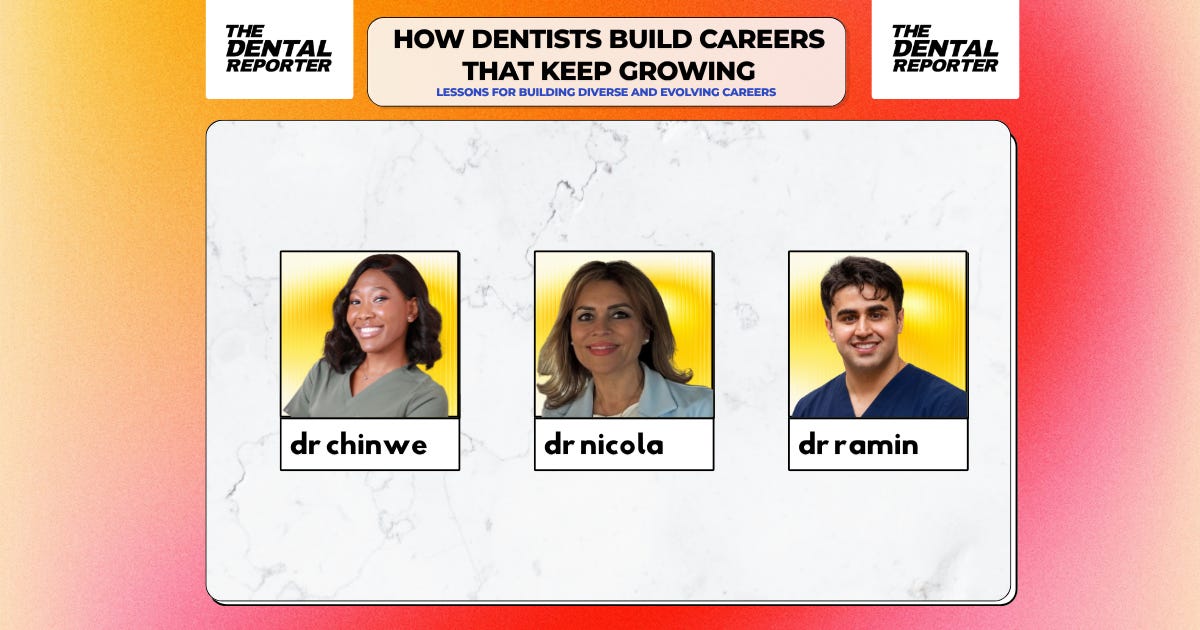
Contributors
Dr Chinwe Akuonu, General and Cosmetic Dentist and Creator, Dental Beauty, GDC: 262461
Dr Nicola Gore, Cosmetic Dentist, Author, Mentor and Founder of the British Iranian Dental Association, Totteridge Dental Studio, GDC: 69866
Dr Ramin Torkizadeh, General and Cosmetic Dentist and Co-Founder of Paste Presents, GDC: 327419


A career in dentistry rarely follows a perfectly mapped route. Priorities change, opportunities appear and the people encountered along the way can influence its direction.
For Dr Chinwe Akuonu, Dr Nicola Gore and Dr Ramin Torkizadeh, very different experiences have shaped where they are today. Here, they share some of the lessons they have collected along the way.
How purpose shapes a career
For Chinwe, one of the experiences that shaped her career happened before she entered the profession.
‘I was 19 years old before I ever visited a dentist for the first time,’ she says. ‘That experience made me realise just how many people grow up without access to dental care or even basic oral health education.’
It opened her eyes to the gap in awareness and prevention, and how closely oral health is connected to overall health and confidence.
‘That curiosity quickly became a purpose. I wanted to be part of changing that narrative by helping people understand that dentistry is not just about fixing teeth, it is about preventing problems, educating patients and improving quality of life.’
Meanwhile, for Nicola, the idea that has shaped her career most is that knowledge becomes more valuable when it is shared.
‘I love clinical dentistry, but I discovered quite early that I got just as much satisfaction from helping another dentist understand something, gain confidence or find their own direction.’
That interest took her beyond the surgery into teaching, mentoring, writing and leadership.
‘I never set out with a master plan to do all these things; one opportunity simply opened the door to another. Looking back, the common thread has always been wanting to make dentistry, and the journey through it, a little easier for those coming after me.’
Ramin’s influences have been more collective.
‘I think of it like getting a dose of greatness from different people. Nobody gave me the whole picture on their own. It is more like I have collected pieces from everyone, how someone handles pressure, how someone else builds a room, how someone else shows up for you when it counts.’
How mentors change your thinking
One mentor in particular changed the way Ramin thought about work ethic: John Marashi. He remembers watching Marashi work seven days a week, travelling between US states and mentoring people along the way.
‘I used to think of work ethic as putting in long hours when you had to. Watching John, I realised it is less about hours and more about consistency, showing up the same way on day seven as you did on day one, even when no one is clocking you.’
For Chinwe, the advice that stayed with her had nothing to do with clinical technique. A mentor told her: ‘Always look after people first, and everything else will follow.’
Watching that mentor put patients before profit changed how she viewed success.
‘They treated every patient with genuine kindness, empathy and respect, regardless of the treatment they needed. It showed me that trust is something you earn through consistency and compassion, not through selling treatment plans.’
Today, she returns to that principle when faced with difficult decisions: ‘If I do what is genuinely in the patient’s best interest, I am making the right choice.’
Nicola’s first mentors were her parents, who taught her to work hard and not to fear criticism or failure. Over time, however, her definition of mentorship has changed.
‘My dental students have become some of my greatest teachers. Their questions challenge me and sometimes make me rethink things I have done for years.’
Patients, colleagues, students and people she has met along the way have all helped shape her.
How careers keep growing
More than 30 years after qualifying, Nicola says some of the opportunities of which she is proudest have arrived later in her career.
‘Nobody tells you that you can reinvent yourself at any stage of your career.’
Alongside successes, there have been wrong turns, disappointments and self-doubt.
‘I have learnt not to fear those moments. Your career is not a race, and there is no deadline for becoming the person you want to be. You do not have to peak early. Sometimes the most exciting chapter is the one you have not written yet.’
For Ramin, one thing nobody tells you is the value of authenticity and collaboration.
‘I feel like we got sold this idea that you have got to be cutthroat, got to compete, got to be the loudest person in the room to make it. I just do not buy that anymore.’
‘Every good thing that has happened in my career, if I trace it back, has come from somebody wanting to work with me, not against me. Be kind, be genuine, let collaboration do the heavy lifting.’
Chinwe also challenges the idea that a successful career needs to be mapped from the beginning.
‘Nobody tells you that you do not have to have your entire career figured out from the beginning. It is easy to feel pressure to know exactly where you are heading, what speciality you will pursue or what your next milestone should be. But careers rarely follow a straight line, and that is completely normal.’
Instead, she recommends concentrating on becoming excellent at what is immediately in front of you.
‘Opportunities often come from doing the small things well, staying curious and being open to change. Taking your career one step at a time does not slow you down, it gives you the foundation to build something meaningful and sustainable.’
The different routes taken by Chinwe, Nicola and Ramin will form part of a wider conversation at Dentistry Show London this October, where they will come together for ‘Foundation vs. fast-track: navigating the new dentist’s career dilemma’, exploring different career pathways and the choices facing dentists as they decide what comes next.
Register free of charge here.