A composite day in a private practice
The day had looked tight on paper. By mid-morning it felt tighter in the room.
A morning huddle had set the tone: a quick scan of the diary, complex patients flagged, responsibilities made explicit. Then the day started moving. A consultation ran longer than planned because the patient needed more time. A treatment overran by minutes, then by more than minutes. The reception desk had to keep the story straight while the clinicians stayed focused.
Out front, the team kept the atmosphere steady. Refreshments were offered. The environment stayed intentional, down to the details a patient might not name but would feel. Communication stayed warm and consistent, even when time was being squeezed.
In the background, capacity did its quiet work. An extra team member, rostered in anticipation of a worst-day scenario, absorbed the kind of tasks that would otherwise pull everyone in three directions. Patient flow was protected. Clinical care stayed deliberate.
And under it all sat the part that does not show up in an appointment book: the shared reason for doing the work at this level, and the leadership habits that kept standards from becoming a mood.
Contributors
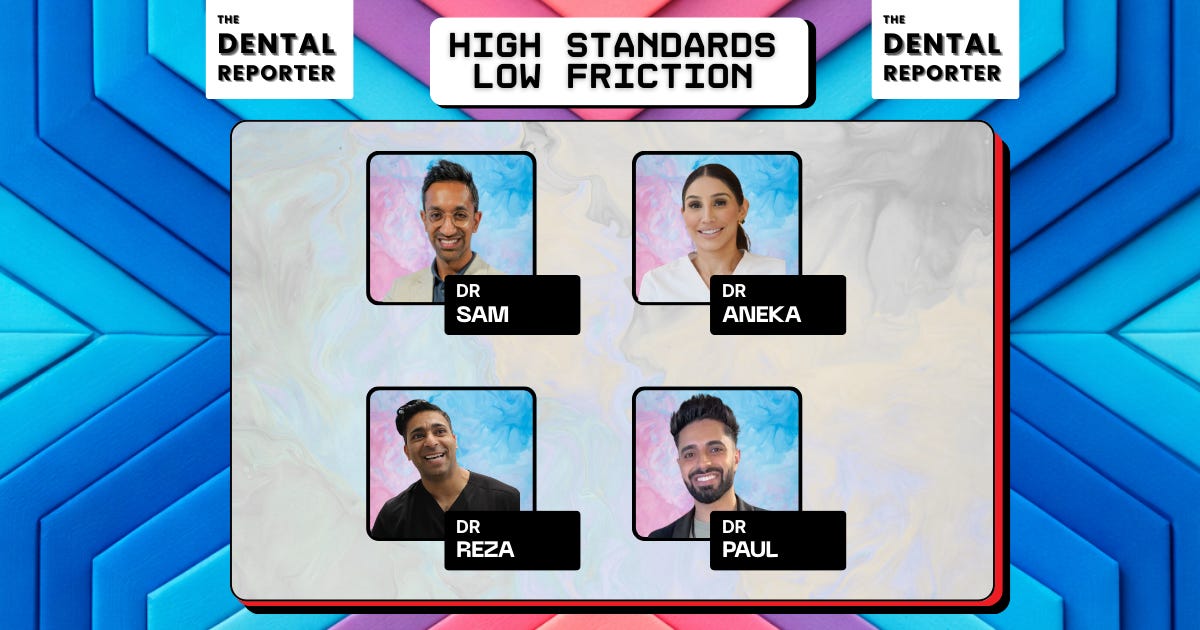
This feature draws on four principal dentists, and what they actually did when pressure was real:


1) The core idea: standards only hold when they are built into the day
High standards are not a speech you give when the practice is calm. They are the default settings your team can rely on when it is not. Low friction is the same. It is not the absence of difficulty. It is the presence of systems that stop difficulty turning into chaos.
Across four practices, the theme was consistent. When pressure rose, the best results came from leadership that did two things at once:
Protected the people doing the work.
Refused to bargain away the quality of the work.
Dr Sam framed it as purpose.
“No team can remain motivated, work through challenges, and avoid burnout without a strong answer to why they are doing what they are doing.”
For him, that “why” was a shared vision of care at a specific level, held by the whole team, not carried by one person.
Dr Aneka framed it as limits and non-negotiables.
“When the diary is full and the team is stretched, the first thing I do is acknowledge the limitations openly.”
Then she held the line:
“Our clinical standards were non-negotiable.”
Dr Reza framed it as planning for pressure, not hoping it would not arrive.
“We deliberately plan for our worst days, not our best.”
Dr Paul framed it as volume versus quality, and he made the choice explicit. When the diary was full,
“we’ve hit our volume target,” but “we care about… clinical excellence and patient care.”
His reminder stayed simple:
“That patient is only seeing us that day.”
The trade-off they refused to make
Under pressure, practices often trade one of three things without admitting it:
Time: cutting steps, compressing appointments, rushing.
Tone: letting stress leak into how patients and colleagues are treated.
Safety and standards: lowering the threshold for what “good enough” means.
These principals refused to make that trade. They adjusted the system instead: huddles, capacity planning, role clarity, and communication habits that protected patient experience while protecting the team.
2) When the diary is full and the team is stretched: empathy without lowering the bar
Pressure does not test whether you have standards. It tests whether your standards are operational.
What empathy looked like, in practice
Empathy started with naming reality. Dr Aneka described opening the day with visible acknowledgement:
“I made it clear that I could see how hard everyone was working.”
She reinforced what mattered:
“Despite the intensity, the team was maintaining strong standards.”
Then she anchored what would not change:
“We agreed we would not sacrifice clinical time, rush procedures, or compromise a patient’s emotional wellbeing.”
Dr Reza made the same move, but earlier in the calendar. He built empathy into workforce planning.
“We roster an additional team member even on days that look manageable on paper.”
On good days, that capacity went into patient experience details,
“offering a custom drinks menu” and maintaining “our curated scents and environment.”
On bad days, it became resilient: tasks redistributed immediately so
“no one felt they had to rush treatment or cut corners.”
Dr Sam focused on what carries a team through long stretches: shared purpose and a leadership structure that keeps performance stable.
“Providing the highest level of cosmetic dentistry starts with a shared vision.”
He credited alignment, “Bespoke Smile” values translated into day-to-day expectations, and a “strong senior leadership structure” with “extremely low staff turnover.”
Dr Paul kept the message direct. The diary being full meant success on volume, but the real target was quality. When the team was stretched, the risk was that it could “affect clinical excellence and patient care.” His standard stayed human:
“That patient is only seeing us that day,” so the team had to keep delivering “a 5-star service.”
His empathy system was cultural and preventative:
“We regularly host socials for team bonding… so minor issues don’t turn into major issues.”
What they changed instead of compressing care
Across the responses, the most effective changes were practical:
Protecting lunch breaks and building short rest breaks.
Rotating roles between high-intensity and lighter sessions.
Extending the diary by 30 minutes, but on a rota basis so the burden was shared.
Adding capacity in advance, rather than improvising when pressure hits.
Reallocating tasks so clinicians could stay clinical and front-of-house could keep patient communication calm.
Dr Aneka put it plainly: in busy periods,
“there’s always an instinct to shorten appointment times or squeeze patients in because saying no feels uncomfortable.”
Her team resisted that and moved the efficiency conversation to systems: standardising processes, streamlining set-ups, and protecting emergency slots.
Tool: The busy-day reset huddle
When to use: When the diary is full, a key appointment is high-need, or the team is already stretched before the first patient is seated.
Acknowledge load: name the pressure, recognise effort.
Restate non-negotiables: do not rush procedures, protect emotional wellbeing, do not compress clinical time.
Assign capacity and roles: who owns patient flow, who owns clinical focus, who supports emergencies.
Plan micro-breaks: protect lunch, add short resets.
Reinforce purpose: remind the team why standards matter, and that each patient’s day is unique.
What to borrow
Start the day by naming pressure out loud, then naming what will not change.
Replace “squeezing in” with role clarity, rota-based extensions, and protected breaks.
Build empathy into planning, not just into pep talks.
Keep one sentence ready that anchors purpose when the day becomes mechanical.
3) Keeping patients cared for when time moves: the calm protocol
Patients rarely judge you on the existence of a delay. They judge you on the experience of it.
Diary Architecture: the best delay is the one you do not create
Dr Sam did not describe a practice constantly recovering from lateness. He described one designed to avoid it.
“With our dentistry we have the luxury of time. Consults are lengthy, treatments are lengthy. Running early is more common than running late.”
That is Diary Architecture. It is a scheduling stance, not a personality trait. It assumes relationship-led care needs time, and it builds that into the operating model so the team is not constantly borrowing minutes from patient experience.
When there was a planned delay, the response stayed relational and calm.
“We call the patients and advise them to enjoy the local amenities.”
While waiting in the clinic, the focus was “comfort, refreshments and communication.” The concierge and non-clinical teams carried a large share of the experience, and that mattered:
“It’s all about relationships.”
When delays happened, leadership set the temperature
Dr Aneka described the chain reaction that turns one delay into a stressful session, and how she stopped it.
“The key… is preventing one delay from snowballing into a stressful session.”
She modelled calm, kept nurse communication coordinated, and made proactive diary decisions early:
“Is there something booked later that could safely be moved?”
She also described a small habit that mattered because it was repeatable:
“Sometimes it’s as simple as taking a few slow, deep breaths in surgery or stepping out for 30 seconds to refocus.”
Dr Reza framed calm as structure and trust. He invested in an experienced management team with
“three clear areas of focus: one lead dedicated to business growth, one to practice management, and one to clinical management.”
Under pressure, decisions landed quickly, “which prevents stress from escalating.” His point was cultural as much as operational:
“Energy is contagious. If leadership is steady, the team follows.”
When the timing tightened, the front-of-house moved first.
“They keep patients informed, offering refreshments and maintaining a warm atmosphere.”
He was specific about the leverage in small things:
“Proactively updating a patient and keeping the coffee flowing makes a significant difference.”
In his view, those small actions were the difference “between a complaint and an exceptional experience.”
Dr Paul added another angle on empathy. In his practice, a subset of team members had lived the patient experience from the chair, having had treatments completed. That lived experience sharpened how they handled waiting and uncertainty. It made empathy practical, not theoretical, because they understood both sides of the exchange.
Tool: The delay protocol
When to use: When a session starts slipping, a procedure runs long, or a patient has been waiting long enough that uncertainty will become frustration.
Decide early if the day needs reshaping: review the diary ahead and move what can safely move.
Keep the clinician and nurse aligned: reduce friction by coordinating in-the-room communication.
Move communication forward to front-of-house: update patients proactively, not reactively.
Offer comfort and keep the environment steady: refreshments, calm atmosphere, consistent warmth.
Treat the patient as a person with a schedule: apologise sincerely, check constraints, show respect.
Where possible, design time so delays are rare: build length and relationship into the diary, not only into the consult.
What to borrow
If you cannot control the delay, control the uncertainty.
Decide early whether something later can be moved safely, rather than hoping the day will fix itself.
Make front-of-house the first response, not the last resort.
Treat Diary Architecture as a leadership tool, not an admin task.
4) Internal motivation: what makes people care and improve over time
Motivation in dentistry is rarely a mystery. It is usually a maintenance issue. The question is not what inspires people once. It is what keeps them consistent when the work repeats and the day gets tight.
Four drivers, one shared principle
Dr Sam built motivation on purpose and shared direction. The “why” was not a poster.
“It’s an undercurrent that is the foundation of everything we do.”
Dr Aneka named two drivers: connection and recognition.
“When people feel personally connected to patients and genuinely appreciated for their contribution, they care more.”
She described practical ways to build connection: remembering personal details, note-taking on small things that matter, and celebrating patient moments so care stayed relational.
Recognition, in her view, had to be specific. She described “specific praise in team huddles” and private thanks for how someone handled a difficult situation. The mechanism was simple:
“When people feel seen and valued, their confidence grows.”
Dr Reza built motivation around professional passion, ownership, and growth. He started at hiring:
“We only bring in individuals who genuinely care about the profession and who are committed to excellence.”
Then he reinforced it through development and responsibility: structured growth through courses, “clear progression pathways,” and involving people in decisions so they felt trusted rather than micromanaged.
Dr Paul anchored motivation to a shared philosophy of quality. “Having the right team members that buy into this philosophy” was how excellence stayed consistent. He also described a pressure-release valve that stopped resentment building quietly: team socials where staff could speak candidly “in a relaxed environment so minor issues don’t turn into major issues.”
Tool: Recognition and ownership that reinforce standards
When to use: When the diary is busy for weeks, when morale feels flat, or when you need consistency more than you need a motivational talk.
Tie motivation to purpose: restate why the work matters at this level.
Build patient connection as a habit: encourage remembering personal details, and capture them for continuity.
Recognise what went well, specifically: use huddles for precise praise, and private thanks for hard moments handled well.
Invest in growth and responsibility: create progression and involve people in decisions.
Use socials as a pressure-release valve: give minor issues a safe place to surface before they harden.
What to borrow
If standards are high, recognition has to be equally intentional.
Build connections with patients as a team practice, not only a clinician trait.
Hire for pride in the profession, then invest in development and responsibility.
Use relaxed forums to surface small frictions before they become big ones.
5) One leadership principle, proven by behaviours the team can see
In these practices, leadership principles were not treated as a slogan. They were treated as something the team could point to on a hard day.
Lead by example, but make it visible
Dr Aneka’s principle was direct: “Lead by example.” The proof, in her view, showed up under pressure.
“When the day is running late or something doesn’t go to plan, I’m very conscious of regulating my response.”
Her team saw calm language, a focus on solutions, and issues addressed constructively and privately, so psychological safety held.
She also described visible support that removed the “us and them” dynamic. The team would see that she “personally apologise to patients if we’re running late,” and “step in to help turn over a surgery when needed.”
Dr Sam also led by example, with an added layer: understanding personalities. His principle was
“lead by example, and understand each other’s personalities so we can get the best from everyone.”
The implication was practical. Under stress, miscommunication is friction. Knowing how people receive feedback becomes part of holding standards without inflaming the room.
Dr Reza framed the same idea as credibility: “Practice what you preach.” He linked credibility to consistent modelling. The behaviours he named were straightforward:
“I work hard,” and “I lead with passion for the profession.”
For him, that visible commitment created “energy and pride within the team.”
Dr Paul used similar language and kept it tight:
“Always lead from the front and by example. I would never ask anyone to do anything that I wouldn’t do myself.”
Tool: The two-behaviour test
When to use: When your values sound right but your team still feels unsure what you expect, or when pressure exposes inconsistency.
Name your principle in one line: lead by example, practice what you preach, lead from the front.
Choose two behaviours your team can see: calm response under pressure, visible support, hard work, passion.
Stress-test them on busy days: adapt communication to personalities so feedback lands and standards hold.
Repeat the behaviours until they become the default: consistency is what builds trust.
What to borrow
Make support visible, especially when timing is tight.
Treat communication style as part of performance, not an afterthought.
Pick two behaviours that prove your principle, then repeat them until they are predictable.
6) The system that reduced day-to-day friction and lifted performance
Friction often looked like one of three things: confusion, assumptions, or last-minute firefighting. The antidote was alignment.
Huddles created a shared plan, not more meetings
Dr Aneka described introducing a “10 to 15 minute morning huddle” to review the diary, flag high-need patients, assign roles, and share reminders on standards and patient preferences. The result was practical:
“Fewer last-minute surprises,” “reduced stress,” smoother flow, and better morale because “the team felt heard, involved, and prepared.”
Dr Reza built the same alignment into both ends of the day with structured morning and evening huddles. The problem was clear: as the practice grew, “communication gaps began to appear,” leading to duplicated tasks, missed tasks, and “finger-pointing.” The change was disciplined: concise meetings that clarified ownership. The improvement was immediate:
“Alignment reduces friction while increasing both efficiency and team morale.”
Dr Sam described a broader operating system:
“a system of leadership within each department,” “a daily huddle,” shared documents across sites, and “very clear role allocation and KPIs.”
The mechanism was the same as the others: remove ambiguity before it becomes stress.
Dr Paul pointed to system consolidation through staff scheduling and workflow planning in one place, which made “workflows… more seamless.” He also reinforced a cultural system: regular team socials that kept minor issues from becoming major ones.
Tool: The alignment stack
When to use: When the practice is growing, when tasks are being missed or duplicated, or when the day feels like reactive firefighting.
Morning huddle
Review the diary and highlight complexity.
Flag potential delays or schedule changes.
Assign roles, including emergency support and follow-ups.
Share quick reminders on standards and patient preferences.
Evening huddle
Confirm what needs follow-up.
Review what went well.
Assign ownership so nothing is assumed.
Clear roles and leadership lanes
Define who leads what decisions land quickly and calmly.
Build department-level leadership so responsibility is not vague.
Shared documents and clarity on KPIs
Keep information shared across sites and teams.
Make role allocation explicit so performance is stable.
A pressure-release valve
Use socials to let minor issues surface early, in a relaxed setting.
What to borrow
Add rhythm before you add rules. Huddles create rhythm.
Use morning huddles for prediction, evening huddles for closure.
Put ownership in the room before the day begins, so finger-pointing has nowhere to grow.
Treat system-building as part of patient care, not separate from it.
7) Measures that matter, without becoming metric-driven
None of the dentists described a practice run purely by numbers. They described practices run by standards, with clarity on what mattered.
Dr Paul offered a useful framing: volume versus quality. The diary being full might mean you have hit volume, but that does not guarantee “clinical excellence and patient care.” His standard was patient-specific: “That patient is only seeing us that day.”
Dr Sam talked about “clear role allocation and KPIs,” but in context. The aim was not measurement for its own sake. It was reducing friction by removing ambiguity about who owned what.
Dr Aneka described outcomes you could feel without building a dashboard first: fewer surprises, smoother flow, less stress, better morale, and a patient experience that stayed personal even when busy.
Dr Reza described what improved when alignment was engineered: less confusion, fewer assumptions, and an end to “finger-pointing” because accountability was agreed upfront.
Tool: The quality check-in
When to use: When the diary is full for weeks, when the team feels stretched, or when you sense standards drifting.
Ask these in your huddle or leadership check-in:
Where might today’s pressure tempt us to rush?
What is non-negotiable today?
Who owns patient flow and communication if timing slips?
Where do we need extra capacity, even if it looks fine on paper?
What did we do well yesterday that we should repeat?
What to borrow
Use volume versus quality as a leadership question, not a debate.
Track clarity before you track performance. Confusion is a leading indicator of friction.
Keep measurement tied to standards and patient experience, not to pressure.
8) The Modern Dental Principals’ Motivation Playbook: how to put this into your week
This playbook was not built from theory. It was built from what four principals described doing when the work got busy.
Week 1: stabilise the day
Run a short morning huddle.
Name the non-negotiables and protect breaks.
Rotate roles and share load.
Decide who owns patient communication if timing moves.
Use a small morale reset when intensity rises, and keep it human.
Month 1: reduce friction that repeats
Add an evening huddle if tasks are being missed or duplicated.
Clarify leadership lanes so decisions do not stall.
Consolidate planning so workflows feel seamless.
Use a pressure-release valve socially so minor issues surface early.
Month 3: make standards independent of mood
Reinforce purpose and shared direction, so motivation survives the hard weeks.
Build patient connection into habits and notes, not memory.
Invest in development and responsibility so people grow into ownership.
Keep leading from the front, with calm under pressure as the visible standard.
Tool: The first-week plan, in one page
When to use: When you need a reset that does not require a restructure.
Hold a morning huddle daily for five days.
Protect lunch breaks and add short resets.
Assign roles explicitly, including who owns patient flow and updates.
Rotate high-intensity and lighter sessions where possible.
End the week with a short team check-in, and create a relaxed forum for issues to surface before they grow.
What to borrow
Start with rhythm: huddles, role clarity, and protected breaks.
Build extra capacity before you need it, not after.
Reinforce purpose, then reinforce behaviour.
Keep friction reduction practical: alignment, ownership, and small repeatable habits.
9) Closing: what “high standards, low friction” looked like across four practices
Across four private practices, the patterns were not complicated. They were consistent.
High standards stayed intact when they were not negotiated daily. They were treated as defaults. Low friction appeared when the day had a plan, responsibilities were clear, and leadership steadied the room before stress could spread.
Dr Sam kept returning to purpose and the quiet power of shared direction. Dr Aneka kept returning to calm leadership, explicit non-negotiables, and habits that stopped delay from becoming emotional chaos. Dr Reza kept returning to planning for worst days, building leadership structure, and using alignment to remove finger-pointing. Dr Paul kept returning to a simple truth: volume is not the goal if quality is what you sell, and the patient experience has to stay personal even when the diary is full.
The 7-point checklist: what to borrow
Name pressure early, then name what will not change.
Use Diary Architecture to reduce avoidable lateness, and treat communication as patient care when timing shifts.
Protect breaks, rotate load, and add capacity before the practice needs it.
Reinforce purpose, then reinforce behaviour with specific recognition.
Lead by example in a way the team can see: calm under pressure and visible support.
Install alignment systems: morning huddles, and evening huddles if tasks are being missed or duplicated.
Keep quality visible through simple check-in questions that protect standards from drift.
With thanks to the 4 dentists who shaped this edition