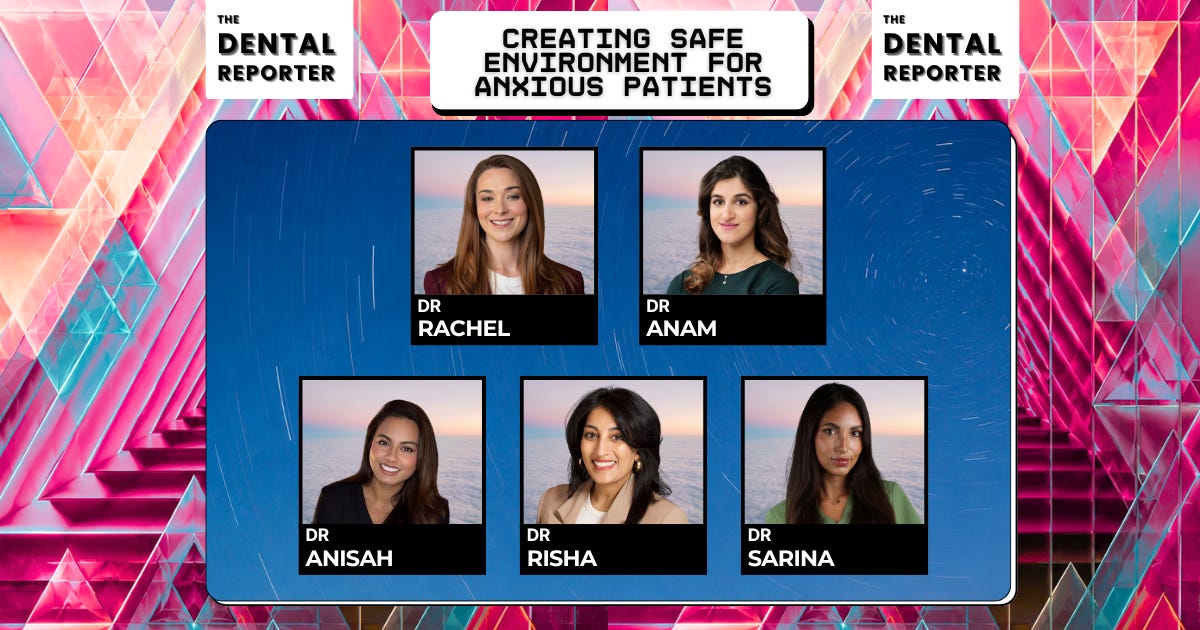
Dental anxiety is rarely a patient's sole diagnosis, but it shapes nearly every other one. It sharpens the perception of pain, complicates anaesthesia, and turns routine recalls into last-minute cancellations and emergency-only visits. The clinical skill in front of the handpiece is only part of the work. What proves harder, and is settled long before treatment begins, is the patient who walks in already braced for it.
Contributors
Dr Rachel Derby, Principal Dentist, Chapel Dental
Dr Sarina Kiani, Associate Dentist, Chelsea Dental Clinic
Dr Anam Sadozai, Associate Dentist, Bupa Dental Care, St Johns
Dr Anisah Begum, Associate Dentist, TLC Dental and Bright and White Dental
Dr Risha Patel, Associate Dentist, Fullham Road Dental


Dr Rachel, Chapel Dental
“Before any examination or treatment begins, my goal is simply to help patients feel that they are in safe hands.”
Dr Sarina, Chelsea Dental Clinic
“If you can put yourself in the mindset of a patient, you will better understand their fears.”
Dr Anam, Bupa Dental Care, St Johns
“Anxiety management is often less about any single technique and more about consistency over time.”
Dr Anisah, TLC Dental and Bright and White Dental
“Creating a familiar, non-judgemental environment and demonstrating genuine care are often the most effective ways to build trust and alleviate anxiety.”
Dr Risha, Fullham Road Dental
“Changing that story, one appointment at a time, is as much my job as the treatment itself.”
The signals patients never say out loud
Dr Risha, Fullham Road Dental, reads the room long before a patient reaches the chair. “It might be the way someone grips their bag in the waiting area, or how they have positioned themselves, perched at the edge of the seat rather than settled,” she says. An over-apologetic tone is another signal. When she notices these cues she slows everything down, dropping her seat to the patient’s level and asking them to face her before anything clinical is reached for.
Dr Sarina, Chelsea Dental Clinic, watches a different set. Patients who repeat questions, speak quickly, or seem distracted draw her attention. Non-verbal signals are often the more telling ones, she notes: limited eye contact, fidgeting, a guarded posture. Some patients communicate by not arriving at all, through cancellations, last-minute excuses, and a pattern of attending only in emergencies.
The walk from reception is not transitional
Several of the dentists here collect patients personally rather than sending a nurse, on purpose.
Dr Rachel, Chapel Dental, meets patients in reception and walks them through herself: a handshake where it is welcomed, steady eye contact, an unhurried introduction. “Patients often respond more to how we communicate than to the words themselves,” she says. Before a patient reaches the surgery, a Treatment Coordinator meets them in a comfortable lounge, away from anything clinical, where they can talk and grow familiar. By the time the surgery door opens, the patient is not facing a stranger.
Dr Sarina makes the same walk but fills it differently, asking about the patient’s day and what is coming up for them. Classical music plays in her surgery, no lyrics, chosen for the calm it reliably produces, and she sits beside the patient before any treatment is raised. Dr Anisah, TLC Dental and Bright and White Dental, also greets from the waiting room and deliberately avoids opening with teeth. “I prioritise understanding the person in front of me,” she says, “why they have come in now, what has led them to seek care.”
Removing the unknown before work begins
Fear of the unknown, several dentists observe, often outweighs fear of the procedure itself. Mapping the appointment before it starts is one of the most consistent tools described.
Dr Anam, Bupa Dental Care, St Johns, works to a framework she calls PACE: pause, ask, clarify, empower. She pauses to read how the patient is doing, then asks what worries them most. Clarity comes next, in plain language. The final step hands control to the patient through clear signals, such as a raised hand, and frequent check-ins.
Dr Anisah places her emphasis on time and pain. She explains the anaesthetic process clearly and reassures patients she will check on them throughout. Patients sense when they are being rushed, she notes, and anxiety climbs when they do.
Control, communication, and the patient who never expected either
Once treatment begins, the same principles carry forward into control signals, narration, and honesty about discomfort.
Dr Rachel is direct about expectations. Dentistry is not a spa treatment, she says, and some discomfort can occur. Full numbness, full information, and a stop signal the patient is encouraged to use form her baseline. Cost, often the unspoken anxiety, she handles away from the clinical room, over a cup of tea and on equal footing, with no pressure to proceed. “If they decide not to proceed with treatment, that is absolutely fine,” she says.
Dr Sarina adapts her communication to the person in front of her. One patient, a former soldier carrying trauma from his time in the military, wanted the minimum and nothing more. She matched that, removing the tooth as quickly as was safe, then planning every later visit in small steps. He kept returning, and the fear receded.
Dr Risha built a framework she calls Narrate, Negotiate, Normalise. Narrate means talking patients through everything in real time, in plain language, because uncertainty is what the anxious mind magnifies. Negotiate means agreeing together what the appointment will and will not involve, so a patient who has had control taken from them experiences the opposite. Normalise means naming the anxiety without drama. Telling someone that most people feel exactly this way is, she says, more powerful than it sounds.
Dr Anisah reaches for comfort in a quieter way, playing a patient’s favourite series on the surgery television during treatment. It often turns into a conversation about shows, and the patient leaves with a recommendation for next time.
Trust built fast, and built deliberately
Not every patient returns across a course of visits. Some arrive once, distressed, with no shared history to draw on.
Dr Risha works in endodontics, which she describes plainly as the most dreaded corner of dentistry. Her patients arrive referred, often after treatment has already failed elsewhere, with no relationship to lean on and frequently a single appointment to work within. The task is to build depth of trust in minutes rather than months.
Her first minutes are deliberate. She introduces herself and her assistant by first name and thanks patients for coming, because for some, getting through the door was the hard part. Then she outlines what will and will not happen, before offering a stop signal: a single gesture that halts everything at once. “Predictability, in those first few minutes, is its own form of reassurance,” she says.
One patient arrived having walked out of two previous appointments elsewhere, apologising and talking to delay the start. Dr Risha paused entirely, acknowledged what they had been through, and set no agenda beyond their comfort. That shift changed them visibly, and the treatment was finished in that single visit. They wrote afterwards to say it was the first time dentistry had not felt like something happening to them, but with them.
When consistency does the work
For the patients who do return, small habits repeated do the work no single technique can.
Dr Anam puts it directly. Anxiety management, in her view, is less about any one technique and more about consistency over time. Patients remember whether they felt rushed, listened to, or ignored across visits, not only in one appointment. Not interrupting, explaining changes before they happen, noticing when someone seems uncertain: these accumulate, and involving patients in even minor decisions shifts them from passive to engaged.
Dr Anisah works to the same end with patients who need evidence before they will trust. One woman had avoided dentistry for years after a procedure in early adulthood left her feeling the wrong teeth had been removed. Pragmatic by nature, she needed to see the problem to believe it. Photographs, intraoral scans, and radiographs grounded the conversation, and forty-five unhurried minutes did the rest. “Visual aids are invaluable in educating patients and grounding conversations in clear evidence,” Dr Anisah says.
Dr Rachel’s most loyal patients often began as her most reluctant. Across several visits, with open conversation and the patient setting the pace, she has watched people commit to treatment they had postponed for years. Their growing confidence, she says, is what reinforces the value of patience.
The direction of travel is clear enough. Anxiety is no longer treated as a hurdle before the real work, but as part of it, handled with systems built deliberately rather than left to instinct. The dentists who design the opening minutes as carefully as the procedure are the ones patients come back to. As the profession competes on more than clinical outcomes, that presence becomes the difference.
Dr Sarina puts it plainly. “Patients are coming to you for you. They will remember how you made them feel, not necessarily what you physically did.”
With thanks to the 5 dentists who shaped this edition