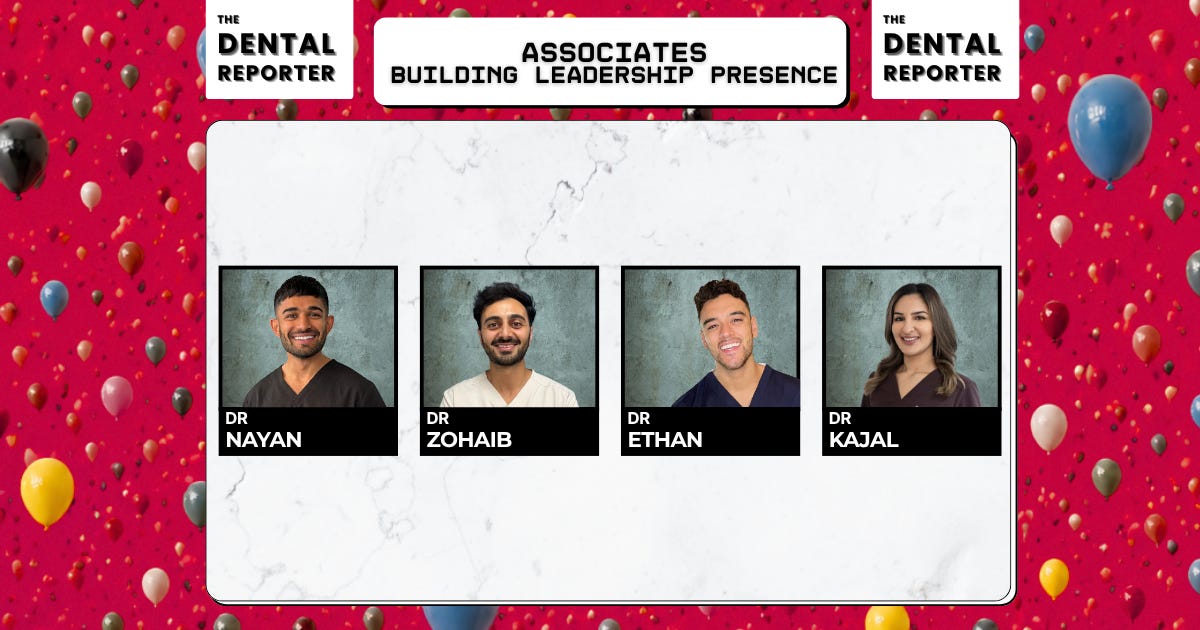
Leadership in a dental practice begins well before any formal conversation about titles or ownership. It accumulates through daily decisions, through how an associate holds themselves when something goes wrong, and through what the team around them quietly notices.
Contributors
Dr Nayan Patel, Associate Dentist, Harley Street Dental Studio, NG Smiles, Watford Smile Clinic, Ascent Dental Care
Dr Zohaib Hassan, Associate Dentist, Brigstock Dental Practice
Dr Ethan R Ananda-Rajan, Associate (Lead) Dentist, Dental-Spa
Dr Kajal Tutt, Associate Dentist, Vogue Dental


Dr Nayan, Harley Street Dental Studio
“I like to approach my role as though I’m running my own clinic within a larger practice. That mindset creates a strong sense of ownership, accountability and responsibility in everything I do.”
Dr Zohaib, Brigstock Dental Practice
“Because I have built excellent relationships with both the team and the principals, I seamlessly act as a midway house between them. This positions me as a trusted bridge that aligns team morale with practice goals.”
Dr Ethan, Dental-Spa
“Influence in the practice comes less from a strict hierarchy and is more a question of the standards you set every day.”
Dr Kajal, Vogue Dental
“My previous experience has given me a strong understanding of the challenges faced in different roles within the practice.”
Running your own room
Dr Nayan, Harley Street Dental Studio and NG Smiles, describes his approach in direct terms. “I like to approach my role as though I’m running my own clinic within a larger practice. That mindset creates a strong sense of ownership, accountability and responsibility in everything I do.”
That posture shapes how he handles a complex case, how he communicates with his nurse, how he responds when a treatment does not go to plan. The mindset has nothing to do with the lease on the building.
Dr Ethan, Dental-Spa, puts it differently but arrives at the same place. “Influence in the practice comes less from a strict hierarchy and is more a question of the standards you set every day.”
Between the principal and the team
One of the more deliberate leadership positions an associate can grow into is what Dr Zohaib, Brigstock Dental Practice, calls the midway house. “Because I have built excellent relationships with both the team and the principals, I seamlessly act as a midway house between them. This positions me as a trusted bridge that aligns team morale with practice goals.”
Growing into that position requires restraint as much as initiative. The principal still leads the practice. What Dr Zohaib has built is the trust to operate in the space between without friction, and that trust rests on a clear sense of boundaries. “We often forget that there are many routes to get from A to B,” he says. “My chosen path does not make someone else’s incorrect.”
The trust that accumulates
Trust is not claimed. It builds through pattern, and tends to reveal itself in small, specific ways. Dr Nayan notes that over time, many team members have booked their own family and friends in to see him. That kind of confidence does not come from a single strong appointment. It comes from watching someone work, consistently, across hundreds of them.
Dr Kajal, Vogue Dental, brings a perspective shaped by an unusual path into dentistry. Before qualifying, she worked as a compliance manager, receptionist, and dental nurse. “My previous experience has given me a strong understanding of the challenges faced in different roles within the practice.” Knowing what a receptionist is managing when the diary shifts unexpectedly, or what a nurse needs during a complex procedure, makes her a more effective colleague. That kind of cross-role understanding is not easy to teach.
Voice and restraint
There is a tension some associates carry, particularly earlier in their careers. Dr Kajal names it directly. “I’ve questioned at times whether speaking up too often might be perceived as overstepping, but I’ve learned that when feedback is constructive and patient-focused, it is welcomed.”
The question is not whether to speak up, but how. Dr Zohaib makes the distinction plainly. “Being vocal does not mean being pushy. It is about communicating why you believe in a certain approach to build understanding.”
Calm as currency
There is a specific kind of leadership that only becomes visible when something goes wrong. Dr Ethan describes the moment an implant motor broke mid procedure, with the spare still in the autoclave. “Even though a glance at my Apple Watch showed me my heart rate was hanging around a frantic 130 bpm, I managed to complete the surgery the old-fashioned way. As long as you let the patient know, in your calmest, least cracking voice, that you’ve got a solution, everyone stays chill.”
Dr Kajal faced a different kind of pressure. During a busy Saturday clinic, unexpected staff shortages coincided with several emergency patients presenting with facial swellings. She helped reorganise the diary with reception, worked closely with her nurse to tighten turnaround times, and kept the day on track. “Keeping calm also helped the other members of the team maintain composure.”
In both cases, the leadership was not announced. It was the person who held the room together.
The role is shifting
Associate dentistry is not what it was. Dr Nayan is direct about this. "Alongside clinical development, there is now a much greater emphasis on communication, patient journey and professional visibility." A portfolio of clinical work, a clear online presence, a professional profile that extends beyond the surgery door: these are no longer extras. They reflect the same proactive mindset that builds influence inside the practice.
Dr Ethan’s late great-uncle, Dr Cohan Rajan, put it plainly: “Once you’ve got the bum in the chair, the room is yours.” Dr Ethan adds the corollary, borrowed from another legendary uncle: “With great power comes great responsibility.” The room being yours is not an end point. It is where the real choices begin.
Leadership presence for an associate does not wait for a title or an ownership conversation. It builds in the room, in how the day is run, in how composure holds when things get difficult. For associates developing that presence now, whether it is possible is not the question. How deliberately they choose to pursue it is.
With thanks to the 4 dentists who shaped this edition