The team at North Cardiff Dental & Implants gathers before the first patient arrives. The first words spoken are not about lab work or running order. Each person names one thing they are grateful for at work and one at home. Only after that does the day’s diary enter the room.
It is a small choice about a first sentence. Across three principal-led practices, that choice is not casual. It is the part of the huddle the principals have thought about most deliberately.
“We open with gratitude, never with criticism,” says Dr Aly, North Cardiff Dental & Implants. The first thing said in the room sets the tone for everything that follows. Dr Jeet, Kai Dental, has reached the same conclusion from a different angle. He has learnt never to open with a problem that needs solving, because starting with an issue makes the meeting reactive and narrows its focus before the team has settled. Dr Gurprit, Teeth & Face, frames it as a habit of leadership rather than a meeting technique. Don’t get straight down to business, she says. Ask team members how they are.
Three practices, three principals, one converging instinct. The huddle is not the place to start with the day’s friction.
Contributors
Dr Jeet Parekh, Principal Dentist, Kai Dental
Dr Aly Virani, Clinical Director, North Cardiff Dental & Implants
Dr Gurprit Jandu, Principal Dentist, Teeth & Face


Dr Jeet, Kai Dental
“An effective huddle is about preparing to care for people well. Without that, a huddle can become operationally efficient, but miss the very things that make care feel exceptional.”
Dr Gurprit, Teeth & Face
“Our morning huddle is our daily team meditation. Without it, we are less focused, less enthused, and not as productive.”
Dr Aly, North Cardiff Dental & Implants
“A well-rested, well-supported, well-fed and well-prepared team will achieve their strategic goals. We focus on process, and in turn this results in outcomes.”
What the schedule cannot tell the team
The diary lists patients, procedures, and times. It does not list the patient who needs to be seen in the downstairs surgery because of mobility, the nervous patient who will need extra reassurance at the door, or the patient returning from a milestone the team should acknowledge. None of that is on the appointment book. All of it shapes how the day actually feels.
Dr Jeet describes the huddle as the place where the details that sit between the appointment book and the reality of delivering care come into view. A complex orthodontic-restorative case needing coordination between clinicians. Lab work due in. A retainer fit to confirm after restorative treatment. Drink preferences a coordinator already knows about. Without those ten minutes, a clinician arrives unprepared, a treatment step is missed, and the patient experience moves from thoughtful to functional.
For Dr Aly, this is the layer that lets each interaction in the building feel personal rather than scripted. If a team member recalls something a patient mentioned at a previous visit, every greeting in the practice that day can build on it.
The cases the huddle caught before they became problems
The clearest evidence sits in the cases where a huddle conversation prevented a quiet failure.
At Kai Dental, a patient was due to have bridges fitted to replace missing lateral incisors after orthodontic treatment. The case was raised in the huddle, which prompted the discussion that new retainers would need to be made immediately after the bridge fit to hold the corrected positions. Without the conversation, the restorative appointment could have proceeded in isolation. Relapse was a realistic outcome.
At North Cardiff Dental & Implants, an immediate load implant restoration had not been booked into the lab diary, leaving the technician double-booked with a shade-taking appointment. The patient coordinator knew all three patients well enough to recall their schedules and preferences, and rearranged the day so the patients felt accommodated rather than rescheduled. No one asked who had made the original error. Dr Aly calls this a protocol-driven solution culture.
At Teeth & Face, a patient had changed her treatment plan over the phone with the treatment coordinator. The two plans were both still on the system. The charting had not yet been updated. Front of house surfaced the inconsistency in the huddle because they had set up the call and were aware a change had been agreed. Dr Gurprit notes that having all team members sitting down together, not at their stations, is what made the resolution quick.
Three different presentations, one mechanism. A piece of information held by one person enters the day before the patient does.
Where awareness ends and ownership begins
A huddle that only reads the diary aloud produces awareness. Awareness is not the same as ownership. The principals describe ownership as what happens when team members start making requests rather than receiving instructions.
At North Cardiff, each person specifies what they will need and when. Dr Aly describes them flagging when X-rays need to be put through, when sterile setups will be needed, where there is an opportunity for a dental plan sign-up, and when a consultation patient may need a private setting for a larger quote. Asking for help is how the day finds its flow.
At Teeth & Face, that ownership is structural. Each team member is responsible for their own surface area of the day. Dr Gurprit’s image is unsentimental: every team member is responsible for their own boiling pot of milk. If no one is watching it, it boils over.
At Kai Dental, ownership shows up in the language of anticipation. The team highlights who needs assistance with stairs, who should be seen downstairs, where extra time may be needed. The conversation has moved beyond the diary and into the patient experience the practice intends to deliver.
The five-minute test
A useful pressure test, asked of all three: if the team were five minutes from the first patient, which agenda item stays.
The answers diverge, and the divergence is the point. For Dr Jeet, the item that survives is recognising small wins. Handwritten cards, patient reviews, thoughtful moments of teamwork. He sees this as the lever that keeps the team’s standard high under the weight of the day. For Dr Aly, the item is each team member’s view of their own day. The individual cannot be ignored for the sake of the practice. For Dr Gurprit, the two-minute version is a single instruction: be sure to check how each patient coming in today needs something from you to ensure a successful day.
Three different non-negotiables. Each one consistent with the practice culture the principal is running.
Want to contribute to The Dental Reporter?
What the textbook gets wrong
Standard huddle advice covers the schedule, patient flags, and production goals. The principals all say the same thing about that template. It is operationally efficient and personally thin.
Dr Aly’s correction is structural. A well-rested, well-supported, well-prepared team will achieve the practice’s strategic goals. Targets set on anxious teams underdeliver. The practice ends its huddle with strategic conversation, but only once the logistics have been resolved for each person in the room.
Dr Gurprit calls the morning huddle the practice’s daily team meditation. It is also where new developments first land. She cites the working assumption that team members may need up to seven contacts with a new idea before it sticks. The huddle is one of those contacts, ahead of the formal training session, and the place where early professional feedback can shape how the change is rolled out.
What the next decade will ask of the morning huddle
Practices are getting more complex. More clinicians on rotation, more technology in the workflow, more sites under one principal, more treatment plans built across more disciplines. The morning huddle is becoming the only daily moment the entire delivery team is in one room. The volume of information it has to absorb is rising, while the time available to run it is not.
The principals running theirs well today are not protecting a meeting. They are protecting the only ten minutes a practice has to behave like one team.
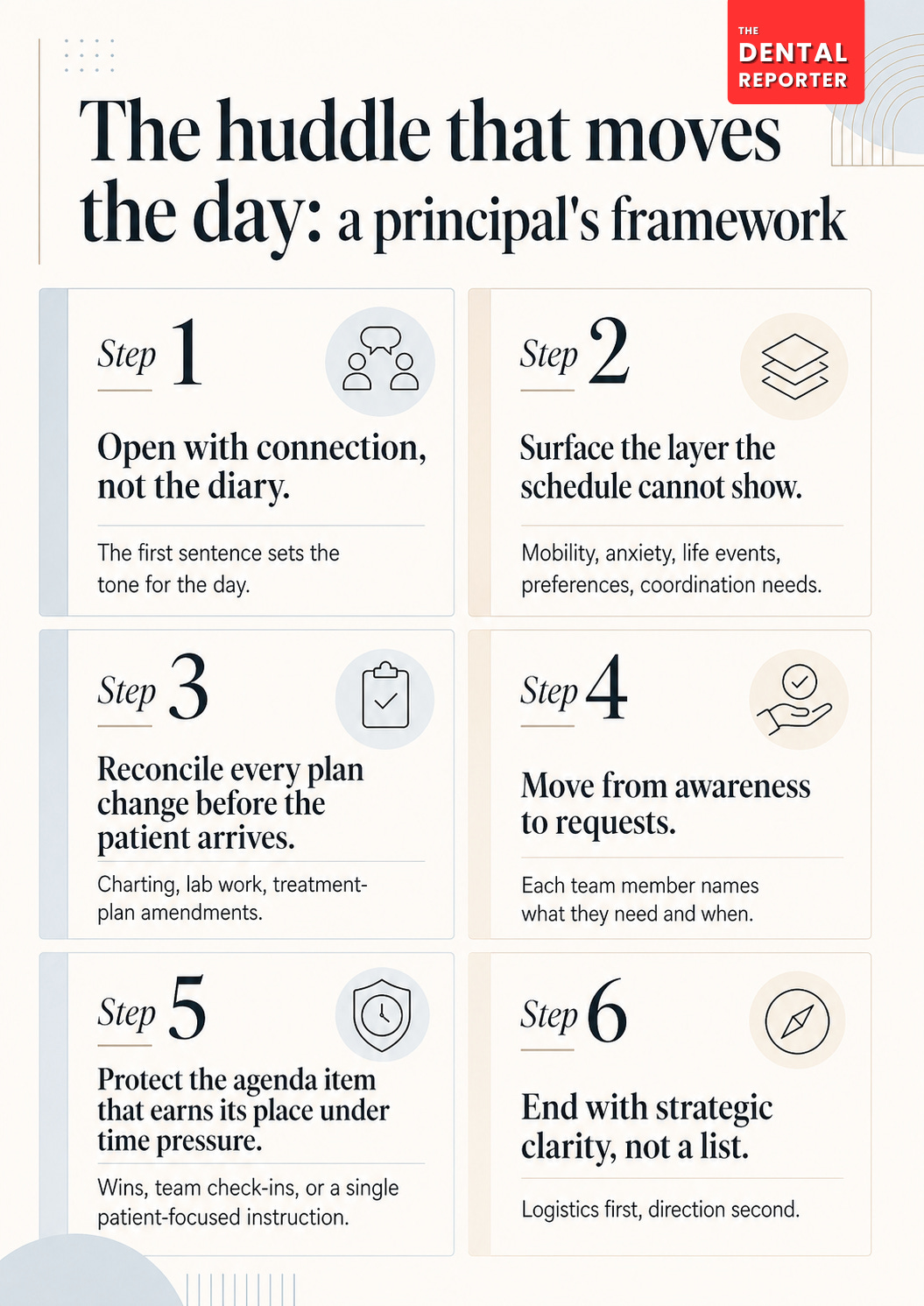
The huddle that moves the day: a principal’s framework
Open with connection, not the diary. The first sentence sets the tone for the day.
Surface the layer the schedule cannot show. Mobility, anxiety, life events, preferences, coordination needs.
Reconcile every plan change before the patient arrives. Charting, lab work, treatment-plan amendments.
Move from awareness to requests. Each team member names what they need and when.
Protect the agenda item that earns its place under time pressure. Wins, team check-ins, or a single patient-focused instruction.
End with strategic clarity, not a list. Logistics first, direction second.
With thanks to the 3 dentists who shaped this edition