The patient sat down before Dr Karim had introduced himself. She smiled. “I’ve already checked your Instagram,” she said. “I feel like I’m in good hands.” Dr Karim of Synergy Dental Leyland had not yet spoken. The consultation had already begun.
That moment captures something the profession is only beginning to articulate. Instagram, long treated as a patient acquisition tool, is doing something more considered than most dentists expected. The outcomes are not always where they assumed they would be.
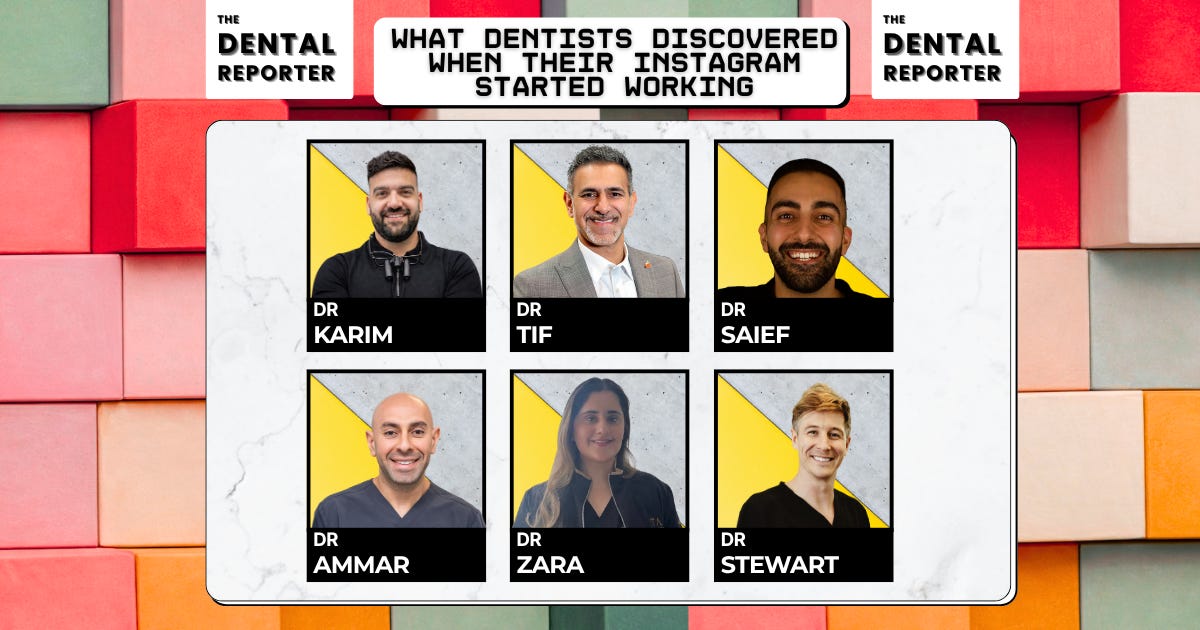
Contributors
Dr Karim Rachidi, Principal, Synergy Dental Leyland
Dr Tif Qureshi, Principal, Dental Elegance
Dr Saief Mahmoud, Associate Dentist, Westmount Dental
Dr Zara Ashraf, Associate Dentist, Greater Manchester
Dr Ammar Al Hourani, Endodontics Specialist, Alexandra Dental Practice & Woodborough House Dental Practice
Dr Stewart Mclean, Associate Dentist, Ringway Dental & 360 Dental Care


The trust that walks in first
What Dr Karim noticed in that first exchange was the quality of what followed.
“The decision-making process becomes more collaborative than persuasive,” he said.
His patient was not waiting to be convinced. She had already arrived at a position. The appointment moved differently as a result.
Dr Zara, Greater Manchester, had a similar experience. A patient walked in and before any formal introduction said, “I already know I’m in safe hands. I follow you on Instagram.” She mentioned a full arch transformation Dr Zara had posted, saying it had made her feel reassured rather than intimidated by the scale of the treatment she was considering. “What struck me most was how the dynamic shifted instantly,” Dr Zara said.
“There was already trust, familiarity, and a sense that she understood my approach before I’d explained anything.”
The practical result was a consultation freed from its earliest stage. Work that would normally anchor the opening of an appointment, managing anxiety and establishing rapport, had already been done. The room became the place where that foundation was confirmed, not laid.
Dr Stewart, Ringway Dental, put it plainly.
“Instagram is your online portfolio. It brings you the patients you’d like, the ones that like your style.”
Patients who respond to a particular approach are already self-selecting before they make contact. The enquiry arrives with a level of alignment that changes what follows.
For Dr Ammar, Alexandra Dental Practice, the dynamic operated differently. His patients arrived reassured not just by clinical results but by the person behind them. Educational content calmed their nerves. Personal elements on the page, family photographs and activities outside dentistry, let them feel they could relate to the clinician before meeting him. The clinical credibility and the human context arrived together.
This shift in the consultation dynamic does not happen because of reach or follower count. It happens because of consistency. A patient who has followed a dentist’s work for months arrives with context, and that context changes the entire register of the appointment. The conversation that might have taken twenty minutes to reach a meaningful point can begin there.
The post that started something else
No one planned the outcomes that mattered most. A workflow breakdown, a behind-the-scenes video, a podcast recorded abroad - each opened a door the dentist had not thought to knock on.
The pattern that most dentists describe is not one of planned content leading to planned outcomes. Consistently, it is a post that did something no one prepared for.
For Dr Karim, it was a full arch case breakdown. Nothing elaborate, just a clear walk-through of his workflow from planning to final result. A few days after posting it, he was contacted by a large dental company that had seen how he explained the process. It led to a conversation about delivering training for them. “I wasn’t trying to promote anything,” Dr Karim said.
“It was just me sharing how I work. But it ended up opening a completely unexpected door.”
Dr Zara’s unexpected moment came from a day-in-the-life video. Nothing polished, just real moments from clinic and a glimpse of what implant dentistry looks like from the inside. A patient saw it who had been delaying treatment for months because of anxiety. After watching the video, she came in. “I saw how calm and in control everything looked,” the patient told Dr Zara. “It made me feel like I could actually go through with this.” The case proceeded.
“Sometimes it’s not the perfect clinical result that connects,” Dr Zara said.
Showing the environment and the human side of the work did what clinical imagery alone could not.
Dr Ammar’s surprise came from a different direction. A podcast recorded in India, covering the limitations of undergraduate dental education, generated over 20,000 views. Beyond the numbers, it sparked a sustained debate about how undergraduate training shapes a dentist’s perception of specialities throughout their career. “It was a real eye opener for me and my team,” Dr Ammar said. A conversation he had not planned to start became one the profession was waiting to have.
Dr Tif, Dental Elegance, found an unexpected audience through content about diet and nutrition drawn from his own experience. Lecturing opportunities followed. Patients began approaching him with a more considered view of their health, leading to blood testing for markers including HbA1c and Vitamin D. Content that was personal in origin built a clinical context that extended well beyond restorative work.
None of these outcomes were designed. Posts that opened unexpected doors shared one quality: the dentist shared something genuine, and the right person happened to be watching.
A reputation that travels
The audience that ends up mattering is rarely the one a dentist set out to build. Peers, companies, and conference organisers were watching long before anyone said so.
There is a particular moment that several dentists describe independently. It is the moment they received a message from a clinician they respected, asking about their approach or a specific case. For most, it was the first indication that the platform had built something they had not set out to build.
Dr Zara described it clearly. A clinician whose work she had followed for years reached out about a specific implant case. “It was a bit surreal,” she said. “I’d always seen myself as the one learning, not the one being asked.” That shift changed how she thought about what she was publishing. It was contributing to a wider professional conversation, not simply producing content.
Dr Saief, Westmount Dental, had a quieter version of the same experience. A message from a clinician he respected noted how he approached cases, specifically the way he explained decisions rather than simply showing results.
“I’ve always seen my content as a way to document and reflect,” Dr Saief said.
He described it as a reminder that how a dentist communicates their thinking matters as much as the outcome itself.
For Dr Ammar, the scale grew considerably. At an international conference, delegates approached him already familiar with his work. Not as a speaker they had been introduced to, but as someone they already knew.
“I couldn’t believe the scope of exposure internationally and how it creates a global audience in such a small field of dentistry,” he said.
The platforms those reputations unlocked were wide-ranging. Dr Karim became a brand ambassador for a major implant company and now runs multiple courses. “The audience has become more than followers,” he said. Dr Zara was invited to visit the Straumann headquarters in Villeret, contributing to conversations around product development as a practising clinician. “Being part of conversations around product development, contributing as a clinician rather than just a user, that’s been far more valuable than any single patient enquiry,” she said.
Dr Ammar’s presence opened international conferences and workshops he would not otherwise have accessed. He described the experience of meeting clinicians whose work reshaped his own thinking and of encountering different ways of practising dentistry from across the globe. Beyond the professional, it allowed him to see places and engage with cultures he would not otherwise have encountered. For a specialist working in a narrow field, the reach had become genuinely global.
Dr Tif found the platform brought other dentists to him as patients, drawn by the long-term follow-up cases he had begun sharing.
“Showing cases with long-term follow-up has far more power than just before and afters,” he said.
It was a shift in content approach that changed both the quality and the source of his professional audience.
Across all of these accounts, the throughline is consistency. None of these outcomes arrived quickly. They built over time, post by post, through a body of work that communicated a clinical identity without performance or artifice.
What it does not carry
Instagram does not close cases, and for dentists whose platforms grow beyond their patient base, it generates real admin weight. The platform has limits, and the dentists who get the most from it tend to be the clearest about what those limits are.
Being precise about what Instagram does not do matters, because the gap between expectation and reality is where most dentists lose their footing.
Straightforward patient acquisition is not guaranteed. Dr Zara framed it directly:
“Instagram builds awareness and trust, but it doesn’t replace the fundamentals, communication, case presentation, and patient rapport in the room.”
Many engaged followers still need multiple conversations and significant reassurance before committing to treatment. The platform supports the decision. Making the decision is another matter.
Dr Tif was candid about a different limitation. The platform does not invite depth. “Very shallow conversations,” he said.
“People don’t seem to want to read, just look at images, which invariably need to be flashy.”
For a dentist whose clinical thinking runs to blood markers and root cause prevention, the platform’s preference for the visual over the substantive is a genuine constraint. The depth of a dentist’s thinking and the surface the platform offers are rarely a natural match.
Dr Ammar noted something less discussed. His platform, built largely for a clinical audience, generates substantial ongoing admin. Messages from clinicians across the globe and queries about cases arrive at all hours.
“It becomes almost a 24-hour shop floor,” he said.
The admin load is a real operational consideration for any dentist whose platform grows beyond a local audience.
Dr Saief was the most measured. “It’s not a shortcut,” he said. “It doesn’t replace clinical skill, communication, or time.” Cases that do not go to plan, difficult conversations, these continue regardless of how the feed looks. A platform shows a considered version of practice. What it does not show is everything else.
“The value hasn’t been in numbers.” “It’s been in the people and the conversations that came from it,” Dr Saief said.
That is a useful frame. Instagram’s value is not in the metric most easily counted. It lies in the quality of what accumulates around a body of work built honestly over time.
What the profession is building
Dentists who posted their thinking, not just their results, built something that compounded over time. That is the pattern the profession has not yet fully caught up with.
The dentists in this piece did not set out to build careers around Instagram. They set out to share their work. What followed came not from a content strategy but from posting consistently and sharing clinical thinking without calculation.
Most dentists still treat the platform as a patient acquisition channel: post results and measure enquiries. That framing accounts for a fraction of what it can do. Dentists who have seen the most from it shifted their thinking early. Instagram is not a diary of outcomes. It is a record of how a clinician works and what they value. That record, built over months and years, becomes something that travels far beyond the practice walls.
The profession is in a period where reputation is no longer confined to geography, word of mouth, or a listing on a directory. A consistent body of clinical work, shared openly, builds something that compounds: peer recognition, professional invitations, teaching opportunities, and patient trust that arrives before the appointment begins. These outcomes do not come quickly. They come to dentists who post not because they have a strategy, but because they have something worth showing.
The appointments that arrive pre-trusting, the training invitations, the conference introductions, the brand partnerships, none of those outcomes were planned. They were earned, post by post, by dentists who shared their work without knowing who was watching.
The profession would do well to take note.
With thanks to the 6 dentists who shaped this edition