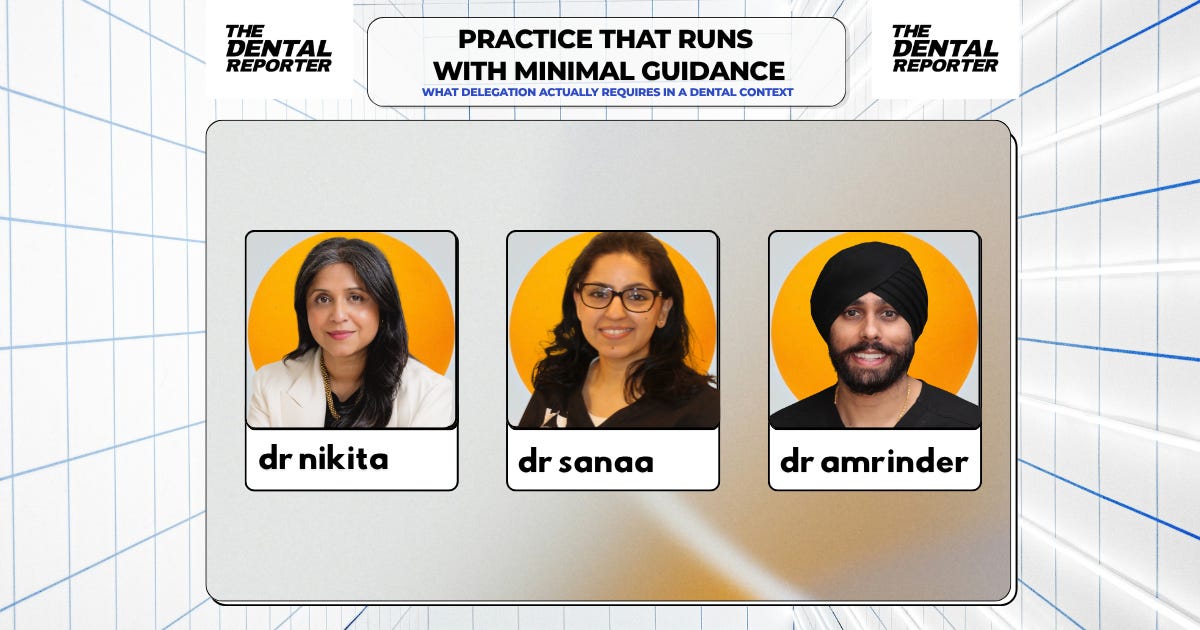
Contributors
Dr Nikita Mehta, Principal Dentist, West House Dental, GDC Number: 76510
Dr Sanaa Kader, Principal Dentist, Indigo Dental, GDC Number: 124494
Dr Amrinder Singh Baidwan, Principal Dentist, Caversham Heights Smile Clinic, GDC Number: 278883


Most principal dentists can name the moment they became the bottleneck. For Dr Nikita, West House Dental, it took a while to recognise.
“I used to think being needed everywhere was the job,” she says. “Every decision came through me, every small call just sat there waiting on me before anything could move. Fine, I called it hands-on. Really I was just standing in the doorway of my own growth, and the practice couldn’t get past me because I hadn’t built anything that let it.”
Dr Amrinder, Caversham Heights Smile Clinic, and Dr Sanaa, Indigo Dental, had a similar experience. He once fielded every new patient enquiry himself, deciding who called back and when. She was involved in almost everything, from the diary and patient queries to ordering and staffing. Her time for clinical dentistry and developing the team shrank as the practice grew.
“As practice owners, we can easily become the bottleneck without realising it,” Dr Sanaa says.
All three have since stepped back. Their accounts follow a similar path, starting with a written standard and a working feedback loop. Trust comes next, tested under pressure, and only then does the principal leave the room.
Written standards: out of the principal’s head
Every new enquiry once ran through Dr Amrinder, and that could not scale. A lead management system changed it. Follow-up moved to the treatment coordinator, with response times set as rules instead of left to memory. Staffing decisions moved to the practice manager once he trusted the judgement behind them.
Clinical work needed a written standard of its own. “Before I could step back from anything, it had to exist outside my head,” he says. “With clinical protocols, that meant writing down the exact standard I expected, not just for treatment planning but for how a patient conversation should feel, so Invisalign cases didn’t quietly drift when I wasn’t the one doing them.”
Dr Sanaa began at the lower-risk end, handing over operational decisions inside clear systems and boundaries. “Initially, I would explain how I would approach a situation and why, then let the team make the decision knowing I was available if needed,” she says. “Gradually, I stepped back.”
Dr Nikita handed the rota and day-to-day decisions to her team. She did not care any less. In her words, caring and controlling “turned out to be two different things.”
Her team needed a reference point more than her presence. “What they actually needed from me was a standard to check their work against, and a project plan solid enough that they didn’t need me hovering,” she says. “I still like knowing what’s going on. I just don’t need to be in the room for it.”
Feedback loops: too little or too much
Writing the standard was only the start. Both Dr Nikita and Dr Amrinder got the distance wrong early on, in opposite directions.
Dr Nikita’s mistake was too little contact. “What went wrong was simple: I skipped the feedback loop,” she says. “I’d hand off a task, no check-ins, and by the end there was a complete mismatch between what came back and what I actually wanted. The team had spent real time on the wrong thing.”
Regular check-ins fixed it quickly. Her team felt supported without her taking over. After a couple of rounds, they began coming back with questions instead of guessing, and that confidence made the workflow faster.
Dr Amrinder did the opposite. When lead follow-up first moved to reception, he found it hard to leave alone. “I kept stepping back in whenever I saw a new enquiry come through, chasing it myself over WhatsApp because old habits die hard,” he says. “It actually caused confusion rather than helping, because the team weren’t sure whose job it was anymore.”
He had asked the team to own a system, and his involvement was undermining it. The answer was a clear standard everyone could see, and then a full step back. “It was uncomfortable at first, watching leads go by without checking in. But that discomfort was the point. If you can’t tolerate it, you haven’t actually delegated anything.”
For Dr Nikita, check-ins were only part of the answer. “The real fix, though, was context,” she says. “Giving the team a precise plan and explaining why we were doing something upfront saved more time than any check-in ever could.”
Building trust: proven under real pressure
Dr Nikita trusted her bookkeeper only after watching her handle every part of the accounts, which Dr Nikita had always kept herself, on paper.
“We ran both systems side by side for the best part of a year, me on paper, her digital, so I could actually watch her learn every subsection: which items went where, how to spot an odd invoice, how to catch a payment that had gone out twice.”
That meant double the work for a while, and it was slower than doing the job herself. “But that year is what let me trust it,” she says. “Once I could see she understood every part of it, not just the easy bits, I wrote it up as a proper process and handed it over completely.”
Dr Amrinder built trust through real cases. He and his treatment coordinator worked through them together until her judgement matched his on the calls that mattered. He describes the moment it clicked.
“The turning point wasn’t writing a process document. It was watching someone handle a genuinely awkward situation the way I would have, without being told to. That’s when you know the decision has actually moved, not just the task.”
He also needed to see that judgement hold on a busy day. “I only felt able to step back once I’d tested that judgement under pressure, not just in a quiet moment,” he says, “because that’s when a system either holds or falls apart.”
Dr Sanaa’s example shows that trust sometimes means letting a decision run its course. She handed more of the recruitment process to her team, and on one occasion the practice hired someone who was not the right fit.
“Rather than seeing it as a failure, we reviewed the process together and identified what we had missed,” she says. “It became a useful learning experience for the team and helped us become much clearer about what we look for when recruiting.”
She adds: “Delegation sometimes means allowing people to make decisions, learn from them and improve.”
Time away: the test of the system
Time away shows what a practice can do without its principal.
For Dr Nikita, that test came in July. “I was away 20 days in July and growth barely dipped,” she says. “My business partner covers day to day, the nurses run their own ordering, and none of it needed me. It’s taken eight years to get here.”
Clear roles and good systems make that possible. Her CRM tool and workflows carry much of the load, alongside voice messaging. The admin team handles patients without coming to her every five minutes. She still runs payroll for the associates and triggers it to the accountant.
Dr Amrinder’s practice “runs on rhythms rather than on me”, in his words. Reception handles enquiries against a clear standard and the manager holds day-to-day decisions. The clinical team knows what he expects without him in the building. Revenue dips slightly when he is out of clinic, which he sees as natural given his role. Special interest dentists now cover those days and bring high value treatment of their own, so the gap has narrowed.
“It took longer than I expected to get here, more like a couple of years of small corrections than one clean handover,” he says. “Every time I thought something was settled, being away would expose the one thing nobody had actually taken ownership of.”
Dr Sanaa’s senior team now runs the practice day to day. “I have senior team members who take ownership of the day-to-day running, staff issues and compliance, with clear boundaries around what needs to be escalated,” she says. Getting there took years. She says much of it came down to learning to let go.
Her view of success changed along the way. “The biggest change was learning that delegation doesn’t mean someone has to do something exactly as I would. If the outcome is right and our standards are maintained, that’s what matters.”
The framework: six steps in order
Across the three practices, the handover followed a recognisable order.
Lower-risk operational decisions first, with clear systems and boundaries in place.
A written standard covering clinical protocols and how a patient conversation should feel.
Context and a precise plan upfront, followed by regular check-ins.
A proving period, through parallel running or live case reviews, until judgement matches the principal’s.
Defined escalation boundaries for the areas that carry real risk.
A full exit from the loop, including the discomfort that comes with it.
Dr Sanaa is clear that stepping back does not mean giving up oversight. “I still retain oversight, particularly where there is clinical, regulatory or significant HR risk, but I no longer need to be involved in every decision,” she says. For compliance, that meant documented processes and regular checks, with clear accountability for each.
Still learning: what each principal keeps
None of the three describes the work as finished.
Dr Nikita has one area left to hand over. “The one place I still show up is a bad month. If income drops, I’m the one building the fix. That’s the last piece, getting a trigger system in place so someone else can do that too.”
Her personal standard shapes how she grows. She has chosen to build capacity through systems and a trained team, rather than seeing more patients with less time each. “The systems did the work I used to do myself.”
For Dr Amrinder, the last handover is a personal one, and ego is the hardest part of it. “It’s easy to say you want the practice to run without you, but much harder to actually watch someone do something differently to how you would have, and let it be right anyway. I had to get comfortable with the idea that my way wasn’t the only way, just the way I was used to.” He is still working on it and says he learns something new every day.
Dr Sanaa has gained time. She now has room to develop clinically and to work on the bigger picture. Most of all, it means being present with her family. “For me, delegation has become less about handing over tasks and more about giving people genuine responsibility and allowing them to grow,” she says.
The work continues in all three practices. Dr Sanaa sums up where it is heading. “I’m still learning to let go, but I’ve realised that a successful practice shouldn’t only work when I’m in the building.”